Immersive VR/AR and Gamification: Transforming the Future of Education
Introduction
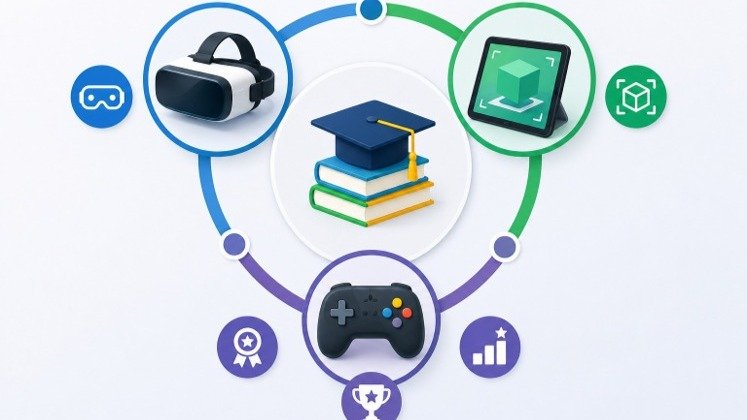
Technology is changing the way students learn, and some of the most exciting innovations in education today are Virtual Reality (VR), Augmented Reality (AR), and gamification. What was once considered futuristic is now becoming a regular part of classrooms, training centers, and online learning platforms worldwide.
These technologies help students learn in a more engaging, interactive, and memorable way. Instead of simply reading about a historical event, students can virtually visit ancient civilizations. Instead of learning medical procedures only through textbooks, healthcare students can practice in safe virtual environments before working with real patients.
As educational institutions continue to embrace digital transformation, VR, AR, and gamification are proving to be powerful tools that improve learning outcomes and increase student engagement.
What Is Virtual Reality (VR)?
Virtual Reality (VR) is a technology that creates a completely digital environment where users can interact with objects and surroundings through specialized headsets.
In education, VR allows students to experience situations that would otherwise be impossible, expensive, or dangerous. For example, students can explore the human body, visit distant planets, or walk through historical landmarks without leaving their classroom.
Many organizations are actively developing VR solutions for learning, including platforms like Unity Education, which provides tools for creating immersive educational experiences.
Benefits of VR in Education
● Creates highly engaging learning experiences
● Improves memory retention through active participation
● Allows safe practice in risk-free environments
● Supports experiential learning
● Makes complex concepts easier to understand
Studies have shown that people tend to remember information better when they experience it rather than simply reading or hearing about it.
What Is Augmented Reality (AR)?
Augmented Reality (AR) enhances the real world by adding digital elements such as images, animations, sounds, or interactive information.
AR enhances real-world environments with digital content, allowing students to interact with lessons and educational materials in real time using smart devices.
Benefits of AR in Education
● Makes lessons more interactive
● Encourages exploration and curiosity
● Supports visual and hands-on learning
● Enhances classroom participation
● Improves understanding of abstract concepts
AR helps bridge the gap between theory and practical understanding, making learning more meaningful and enjoyable.
The Rise of Gamification in Learning
Gamification uses game elements to make learning more interactive and enjoyable. In education, gamification includes features such as:
● Points and rewards
● Badges and achievements
● Leaderboards
● Challenges and missions
● Progress tracking
Students often become more motivated when learning feels like a game. Instead of focusing solely on grades, learners are encouraged to complete challenges, earn rewards, and achieve goals.
Educational institutions are adopting gamification to enhance student engagement, boost motivation, and improve learning outcomes.
How Modern Learning Technologies Improve Student Performance
One of the biggest benefits of VR, AR, and gamified learning is improved knowledge retention, as learners actively engage with content, solve problems, and gain hands-on experience rather than passively receiving information.
For example:
History Education
Rather than reading about ancient Egypt, students can virtually walk through pyramids, explore temples, and observe historical environments. This immersive experience creates stronger memories and deeper understanding.
Medical Training
VR and AR help medical students build confidence by providing hands-on training in realistic healthcare environments.
Science Learning
Students can manipulate molecules, explore ecosystems, and conduct virtual experiments that may be difficult or impossible to perform in traditional classrooms.
Engineering and Technical Training
Learners can interact with complex machinery, understand assembly processes, and practice troubleshooting skills within simulated environments.
Interactive learning helps students turn theoretical concepts into practical skills.
Real-World Applications Across Educational Levels
K-12 Education
Schools are increasingly using VR and AR to make lessons more engaging and interactive. Students can explore geography, science, history, and mathematics through immersive experiences.
Higher Education
Universities are adopting immersive learning technologies for medicine, engineering, architecture, business, and research programs.
Students can gain valuable practical experience before entering professional environments.
Corporate Training
VR and AR help employees learn workplace skills safely through hands-on virtual experiences.
Professionals interested in learning these emerging technologies can find specialized programs through Coursera VR and AR Courses.
Challenges and Considerations
Although VR, AR, and gamification offer many benefits, educational institutions should consider several factors before implementation.
Cost
Advanced VR equipment and software can require significant investment. However, costs continue to decrease as technology becomes more widely available.
Accessibility
Schools must ensure that all students can access immersive learning experiences regardless of their devices or physical abilities.
Teacher Training
Educators need proper training to effectively integrate immersive technologies into their teaching strategies.
Content Quality
Quality content remains the foundation of effective learning.
Resources from organizations like EDUCAUSE Learning Resources help educators stay informed about emerging trends and best practices in educational technology.
The Future of Immersive Learning
The future of education is becoming increasingly interactive, personalized, and experience-driven. As VR, AR, artificial intelligence, and gamification continue to evolve, students will gain access to more engaging and effective learning opportunities.
Future classrooms may include virtual field trips, AI-powered learning assistants, collaborative virtual campuses, and highly personalized educational journeys tailored to individual learning styles.
Conclusion
Virtual Reality (VR), Augmented Reality (AR), and gamification are no longer experimental technologies but essential tools in modern education, helping students understand concepts more deeply and retain knowledge more effectively through immersive learning experiences. From exploring ancient civilizations and conducting virtual science experiments to practicing medical procedures and earning rewards through gamified learning, these technologies are transforming the way education is delivered and will continue to play a growing role in helping students develop skills, build confidence, and prepare for success in an increasingly digital world.
Category: Education
Author: Techstas Research
Read time: 5 min read
Explore how Virtual Reality (VR), Augmented Reality (AR), and gamification are transforming modern education. Discover how immersive learning technologies improve student engagement, knowledge retention, and learning outcomes across school...