How AI Agents Are Transforming Business Operations in 2026
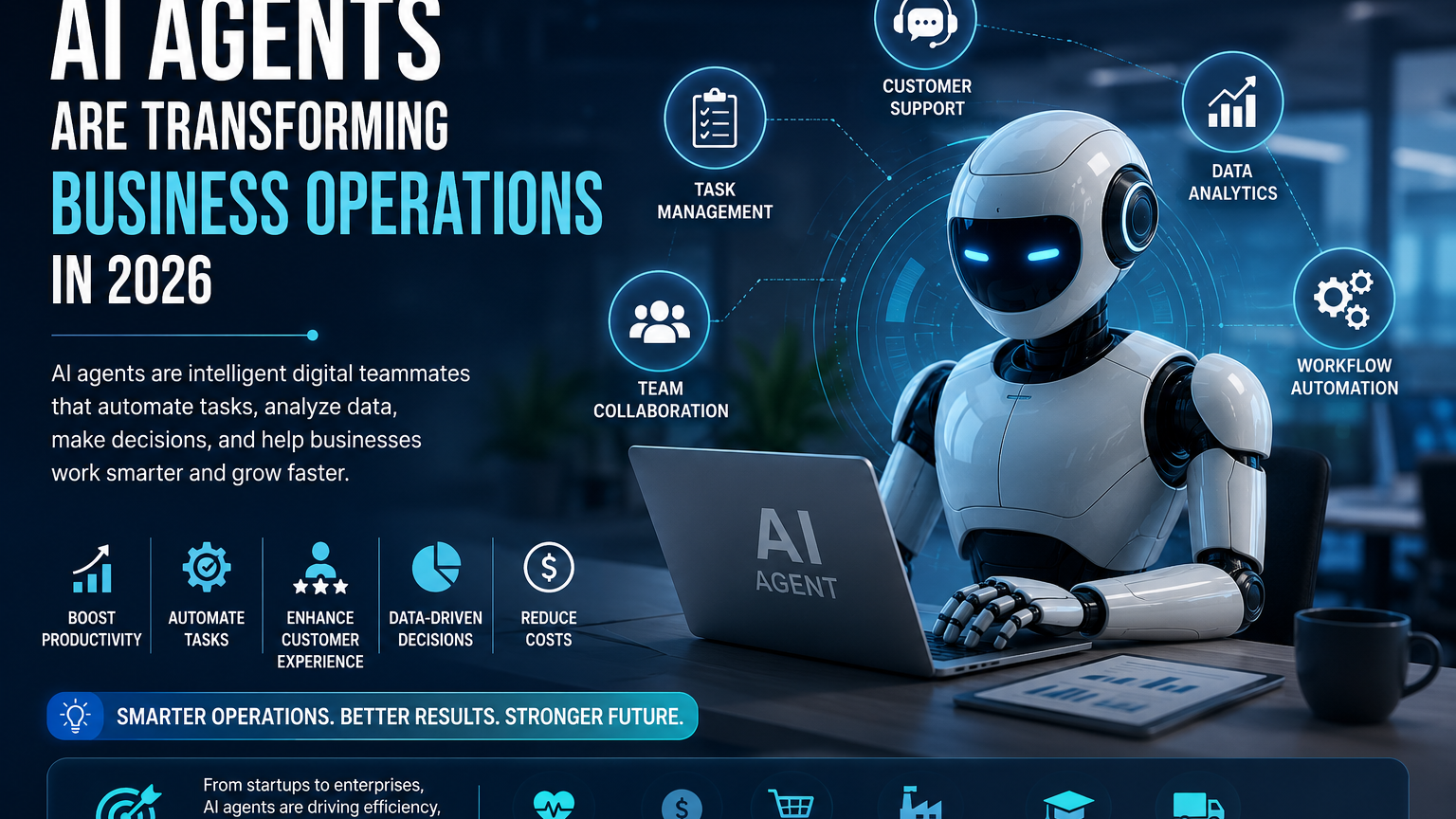
Artificial Intelligence has evolved far beyond simple chatbots and automation tools. In 2026, AI agents are becoming intelligent digital teammates that can analyze information, make decisions, execute tasks, and continuously improve their performance with minimal human intervention.
From startups to global enterprises, businesses are embracing AI agents to streamline operations, enhance customer experiences, and unlock new opportunities for growth. As organizations continue their digital transformation journey, AI agents are quickly becoming one of the most valuable technologies shaping the future of work.
This article explores what AI agents are, how they work, and why AI agents are changing business operations across industries in 2026.
How AI Agents Are Transforming Business Operations in 2026
Artificial Intelligence has evolved far beyond simple chatbots and automation tools. In 2026, AI agents are becoming intelligent digital teammates that can analyze information, make decisions, execute tasks, and continuously improve their performance with minimal human intervention.
From startups to global enterprises, businesses are embracing AI agents to streamline operations, enhance customer experiences, and unlock new opportunities for growth. As organizations continue their digital transformation journey, AI agents are quickly becoming one of the most valuable technologies shaping the future of work.
This article explores what AI agents are, how they work, and why AI agents are changing business operations across industries in 2026.
What Are AI Agents?
An AI agent is an intelligent software system designed to perform tasks independently by understanding goals, analyzing data, making decisions, and taking action. Unlike traditional automation, AI agents can adapt to changing situations, learn from interactions, and collaborate with people or other systems.
Instead of simply following predefined rules, modern AI agents can:
● Understand natural language
● Process large amounts of business data
● Make context-aware decisions
● Complete multi-step workflows
● Learn from previous interactions
● Integrate with existing business applications
Think of an AI agent as a digital employee that works around the clock without needing breaks or constant supervision.
Why AI Agents Are Becoming Essential in 2026
Businesses today face increasing pressure to deliver faster services, reduce costs, and improve productivity. AI agents help organizations meet these expectations by automating repetitive tasks while allowing employees to focus on strategic work.
Several factors are driving the rapid adoption of AI agents:
● Advances in large language models
● Improved cloud infrastructure
● Greater availability of business data
● Rising customer expectations
● Increased demand for operational efficiency
As AI technology becomes more accessible, companies of all sizes can benefit from intelligent automation.
How AI Agents Are Transforming Business Operations
1. AI Agents for Smarter Customer Support
Customer service is one of the areas experiencing the biggest transformation. AI agents can:
● Answer customer questions instantly
● Resolve common issues automatically
● Track support tickets
● Provide personalized recommendations
● Escalate complex cases to human representatives
This leads to faster response times, improved customer satisfaction, and lower support costs.
2. Automating Repetitive Tasks with AI Agents
Many daily business activities consume valuable employee time. AI agents can automate tasks such as:
● Scheduling meetings
● Managing emails
● Creating reports
● Processing invoices
● Updating CRM records
● Data entry
Automation allows teams to focus on innovation instead of repetitive administrative work.
3. Better Decision-Making Through Data Using AI Agents
Businesses generate enormous amounts of information every day.
AI agents analyze this data in real time to identify trends, predict outcomes, and provide actionable recommendations.
Instead of manually reviewing spreadsheets, decision-makers receive valuable insights within seconds.
Examples include:
● Sales forecasting
● Demand prediction
● Financial analysis
● Inventory optimization
● Customer behavior analysis
4. AI Agents for Personalized Customer Experiences
Today's customers expect businesses to understand their preferences.
AI agents help organizations deliver personalized experiences by analyzing customer interactions, purchase history, and browsing behavior.
Businesses can provide:
● Personalized product recommendations
● Tailored marketing campaigns
● Customized customer support
● Individualized communication
This improves customer engagement and increases conversion rates.
5. Improving Human Productivity with AI Agents
AI agents are not replacing employees—they are helping them work more efficiently. Employees can use AI agents to:
● Research information quickly
● Summarize documents
● Draft emails
● Generate reports
● Analyze market trends
● Prepare presentations
By reducing manual work, teams have more time to focus on creativity, strategy, and problem-solving.
Industries Benefiting from AI Agents
AI agents are making a significant impact across many industries.
Healthcare
● Appointment scheduling
● Medical documentation
● Patient support
● Administrative automation
Finance
● Fraud detection
● Risk assessment
● Customer assistance
● Financial reporting
Retail
● Inventory management
● Personalized shopping experiences
● Order tracking
● Customer support
Manufacturing
● Predictive maintenance
● Supply chain optimization
● Quality monitoring
● Production planning
Education
● Personalized learning
● Student support
● Course recommendations
● Administrative management
Benefits of AI Agents for Businesses
Organizations adopting AI agents often experience measurable improvements, including:
● Increased operational efficiency
● Faster decision-making
● Reduced operational costs
● Improved customer satisfaction
● Higher employee productivity
● Better data utilization
● Scalable business operations
● Enhanced business intelligence
These benefits help companies remain competitive in an increasingly digital marketplace.
Challenges Businesses Should Consider
While AI agents offer tremendous advantages, successful implementation requires careful planning.
Businesses should consider:
● Data privacy and security
● Integration with existing systems
● Employee training
● Ethical AI usage
● Continuous monitoring and improvement
Organizations that combine AI capabilities with human expertise achieve the best long-term results.
The Future of AI Agents
The next generation of AI agents will become even more autonomous, collaborative, and intelligent.
Future developments may include:
● Multi-agent collaboration
● Advanced business process automation
● Real-time strategic planning
● Predictive decision-making
● Industry-specific AI assistants
● Deeper integration with enterprise software
Rather than replacing human workers, AI agents will increasingly serve as intelligent partners that enhance productivity and innovation.
How Businesses Can Get Started with AI Agents
Organizations interested in adopting AI agents should begin with clear business objectives. A practical approach includes:
1. Identify repetitive tasks suitable for automation.
2. Evaluate existing business processes.
3. Choose AI solutions that integrate with current systems.
4. Start with a pilot project.
5. Measure performance and refine workflows.
6. Expand AI capabilities based on business needs.
A phased implementation reduces risk while maximizing long-term value.
Conclusion
AI agents are no longer a concept for the future—they are transforming how businesses operate today. From automating routine tasks and enhancing customer service to delivering data-driven insights and improving productivity, AI agents are helping organizations become more efficient, agile, and competitive.
As technology continues to evolve, businesses that embrace AI strategically will be better positioned to adapt, innovate, and grow in an increasingly digital world. Whether you run a startup or a large enterprise, now is the time to explore how AI agents can support your business goals and drive sustainable success
Frequently Asked Questions (FAQs)
What is an AI agent?
An AI agent is an intelligent software system that can understand goals, analyze information, make decisions, and perform tasks with minimal human intervention.
How are AI agents different from chatbots?
Traditional chatbots mainly answer questions, while AI agents can plan, reason, execute multi-step workflows, integrate with business systems, and learn from interactions.
Which industries benefit most from AI agents?
Healthcare, finance, retail, manufacturing, education, logistics, and customer service are among the industries seeing significant benefits from AI agent adoption.
Can small businesses use AI agents?
Yes. Many AI agent platforms are scalable and affordable, allowing small and medium-sized businesses to automate processes, improve customer service, and increase productivity.
Are AI agents replacing human jobs?
In most cases, AI agents are designed to assist employees by automating repetitive tasks. This enables people to focus on strategic, creative, and high-value work rather than routine activities.
Category: AI & Machine Learning
Author: Techstas Research
Read time: 5 min read
Explore how AI agents are reshaping businesses in 2026 with intelligent automation, data-driven decisions, and enhanced customer experiences.