
6 Cybersecurity Best Practices for Businesses in 2026
Protect your business from cyber threats with six practical cybersecurity best practices covering passwords, phishing, updates, backups, access…

Learn how businesses can adopt AI successfully with a practical 7-step roadmap covering AI tools, data readiness, security, employee training, and results.
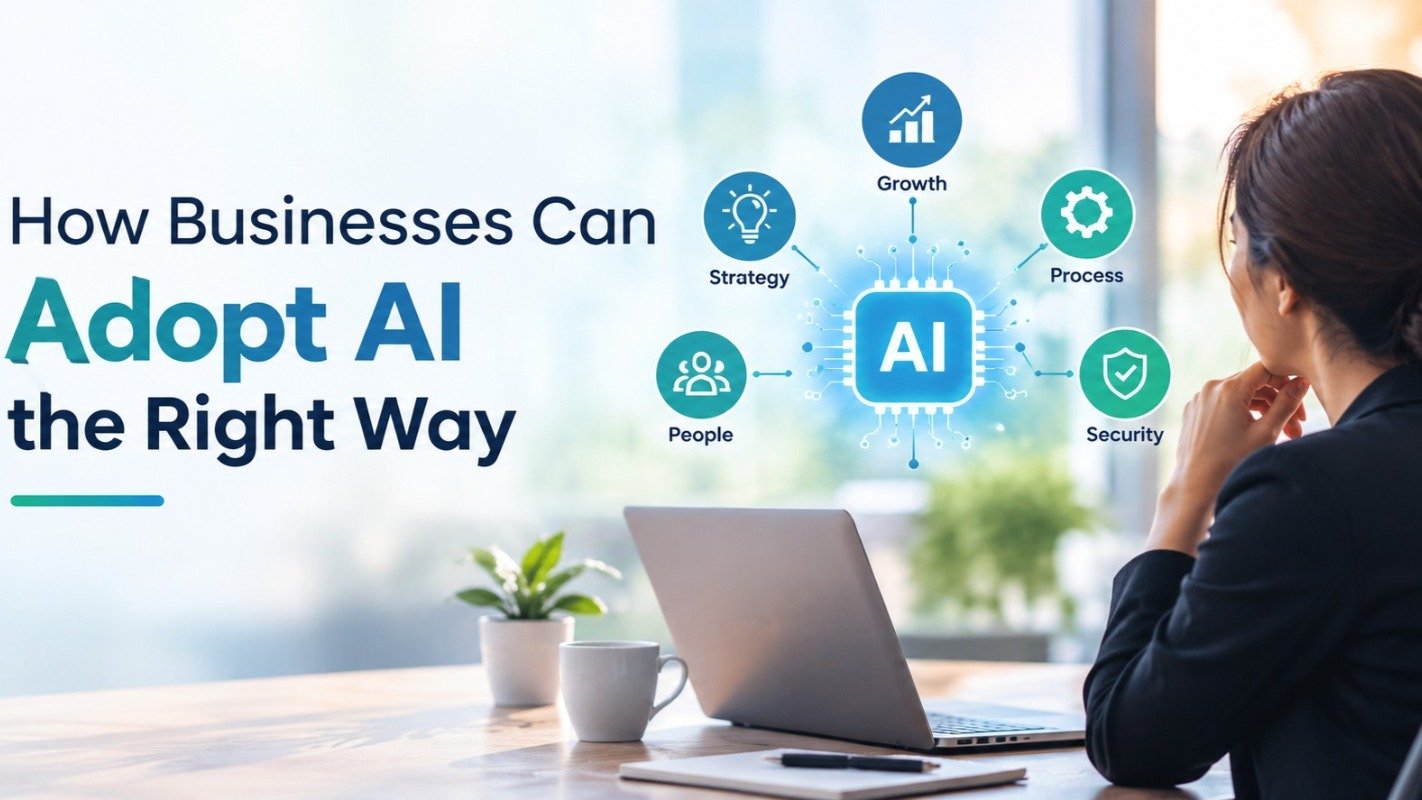
AI adoption for businesses is no longer optional, but many companies are still unsure where to begin. Some rush in with expensive tools and see little result, while others wait too long and fall behind. AI works best when it is introduced with a clear plan. Here is a simple 7-step guide.
1. Start With a Business Problem, Not an AI Tool
Instead of choosing a tool first, ask: Which task takes the most time or causes the most errors in our business? Good starting points include customer queries, invoice processing, report writing, and data analysis.
2. Begin With a Small AI Pilot Project
Pick one team and one use case, and run a pilot for four to six weeks. Define success clearly, such as hours saved or faster response time, and collect feedback before deciding to expand.
3. Prepare and Organise Your Business Data
AI is only as good as the data behind it. Clean your key business data, decide who owns each source, and remove duplicates and outdated records.
4. Explore AI Agents Carefully
Beyond chatbots, AI agents can now carry out multi-step tasks such as sorting emails or preparing reports. Start with low-risk tasks, limit what systems they can access, and review their actions regularly.
5. Prioritise AI Security and Data Privacy
Choose tools with clear privacy policies, set rules on what employees can share, and limit access by role. A simple internal AI usage policy can prevent costly mistakes.
6. Train Your Team and Keep Humans in the Loop
Explain that the goal is to remove repetitive work, not people. AI can sound confident even when it is wrong, so always have a person review important outputs like customer communication and financial figures.
7. Measure AI Results and Improve
After the pilot, review time saved, cost savings, quality, and feedback from employees and customers. Use these results to decide where to expand next.
AI Adoption Checklist for Businesses
Identify one clear business problem
Run a small AI pilot project
Organise your data
Start with low-risk AI agents
Set security and privacy rules
Train your team and review outputs
Measure results and improve
Final Thoughts: Make AI Adoption a Long-Term Strategy
AI is no longer a future idea. It is already changing how businesses work, serve customers, and make decisions. But the real advantage does not come from using the most tools or being the first to adopt. It comes from using the right tools, for the right problems, with the right safeguards in place.
Start with one clear problem, test it with a small pilot, protect your data, and let people review what AI produces. Businesses that treat AI adoption for businesses as a long-term journey, not a quick fix, will be the ones that see lasting results.
Keep reading

Protect your business from cyber threats with six practical cybersecurity best practices covering passwords, phishing, updates, backups, access…
Discover five practical ways to use AI tools to save time on writing, summarizing, design, planning, and learning. Get simple tips to boost…
Employees are increasingly using AI tools to boost productivity—but without proper oversight, they could be exposing sensitive company data…
Our team can help you put these ideas to work — from AI creatives to the systems behind them.