
6 Cybersecurity Best Practices for Businesses in 2026
Protect your business from cyber threats with six practical cybersecurity best practices covering passwords, phishing, updates, backups, access…

Employees are increasingly using AI tools to boost productivity—but without proper oversight, they could be exposing sensitive company data. Discover the risks of Shadow AI, how it threatens data security, and the steps businesses can take to encourage safe, responsible AI adoption.
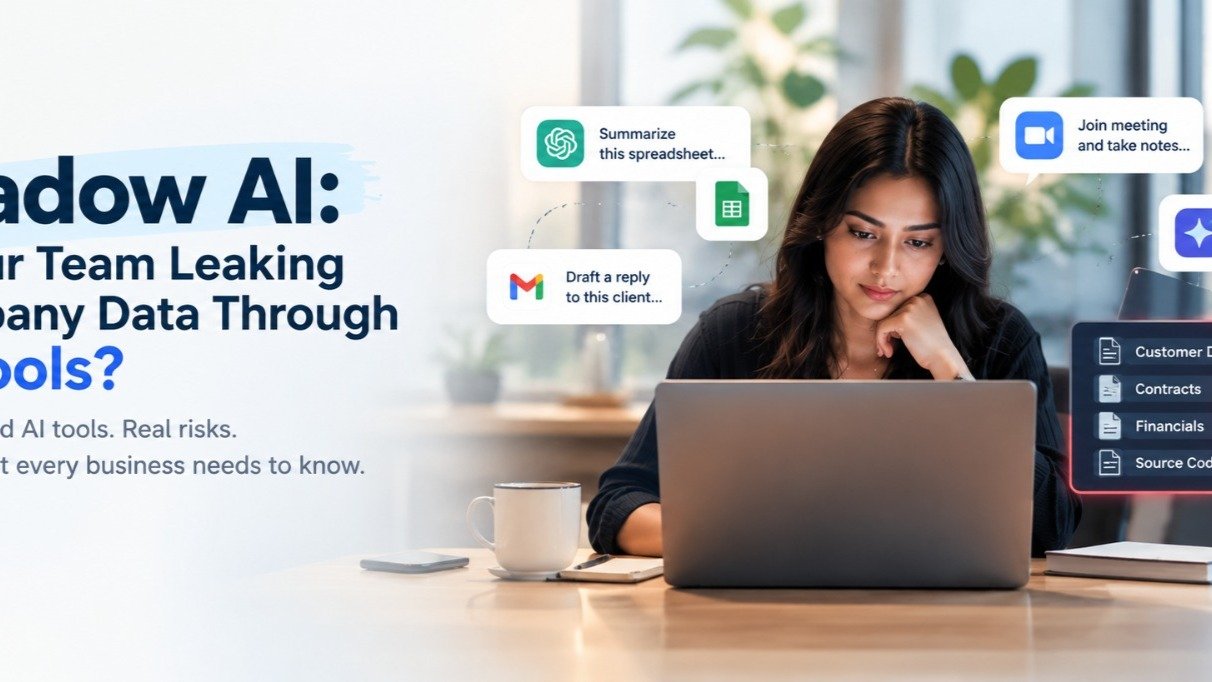
Right now, someone on your team may be pasting client data into a free AI chatbot: a sales executive drafting a reply, an accountant summarizing a spreadsheet, a manager running an AI note-taker in every meeting. Nobody is being careless on purpose, and nobody told IT.
Shadow AI is the use of AI tools at work without the approval or oversight of IT or security teams. It is the newest form of shadow IT, and for most businesses it is probably already happening.
What Is Shadow AI?
Shadow IT meant unapproved apps and devices. Shadow AI is harder to spot because the “tool” is often just a browser tab, and the risk lies in what people type into it. An ISMG expert panel predicts that shadow AI will overtake shadow IT as the top user-driven enterprise risk. That is a forecast, not measured data, but it matches what many IT teams see.
The Four Real Risks OF Shadow AI
Data exposure: Customer details, pricing, or contracts entered into tools you haven’t reviewed. Whether a tool stores inputs or trains on them depends on the provider and plan, so each tool needs its own check.
Compliance gaps: Regulated or personal data may be handled in ways your contracts or policies don’t allow.
Wrong answers: AI output can sound confident and still be incorrect. Unchecked, it ends up in proposals and reports.
No visibility: You can’t secure or audit what you don’t know exists.
Why Banning AI Usually Fails
Staff use AI because it saves time. If you block everything without offering an alternative, usage doesn’t stop. It moves to personal phones and home laptops, where you see even less. The better goal is to make safe use easy and risky use visible.
A Six-Step Action Plan for Managing Shadow AI
Discover. Ask teams openly which AI tools they use. Keep it no-blame.
Classify data. Decide what must never go into an AI tool: customer personal data, passwords, contracts, unreleased financials.
Provide a safe option. Approve at least one AI tool with proper business terms.
Write a one-page policy. Allowed tools, forbidden data, who to ask.
Add controls. Depending on your size and budget: access management, data loss prevention, blocking high-risk tools.
Train and review. Use real examples and revisit every few months. Tools change fast, including AI features quietly added to software you already use.
Shadow AI Risk Assessment
Answer yes or no:
Do we know which AI tools our staff use?
Do we have a written AI usage policy?
Do employees know what data must never be entered?
Do we offer an approved AI tool?
Are AI note-takers and browser extensions covered by our policy?
Is AI-generated content reviewed by a person before it reaches clients?
Did we train staff on this in the last 6 months?
Mostly “no” or “not sure”? That itself is the finding. Visibility is step one.
Common Shadow AI Management Mistakes
Blaming employees instead of fixing the process
Writing a policy without explaining the reason
Approving a tool once and never rechecking it
Treating this as only an IT issue, when legal, HR, and management all have a role
Conclusion
You can’t stop employees from discovering AI, and you shouldn’t try. What you can do is give them safe tools, clear rules, and a company that knows what is happening. Start small: one conversation, one policy page, one approved tool.
Keep reading

Protect your business from cyber threats with six practical cybersecurity best practices covering passwords, phishing, updates, backups, access…
Discover five practical ways to use AI tools to save time on writing, summarizing, design, planning, and learning. Get simple tips to boost…
Multi-Cloud vs. Hybrid Cloud: Which Is Right for Your Business
Our team can help you put these ideas to work — from AI creatives to the systems behind them.