How ChatGPT and AI Tools Are Changing Student Learning
Introduction
Artificial Intelligence (AI) is rapidly transforming the education sector, changing how students learn, research, and develop new skills. Tools like ChatGPT, Gemini, Microsoft Copilot, and other AI-powered learning platforms are becoming valuable educational resources for students worldwide. These technologies help learners access information quickly, improve productivity, and create personalized learning experiences.
As education continues to evolve, understanding how AI tools impact student learning has become increasingly important for students, teachers, and parents alike.
What Is ChatGPT and How Does It Help Students?
ChatGPT is an AI-powered conversational assistant that can answer questions, explain complex concepts, generate content, and support learning across various subjects.
Students use AI tools to simplify difficult topics, improve writing skills, and gain instant access to educational information.
Common uses include:
● Homework assistance
● Research support
● Essay planning
● Exam preparation
● Language learning
● Coding practice
● Study summaries
By providing immediate guidance, AI tools help students learn more efficiently and independently.
Benefits of AI Tools in Student Learning
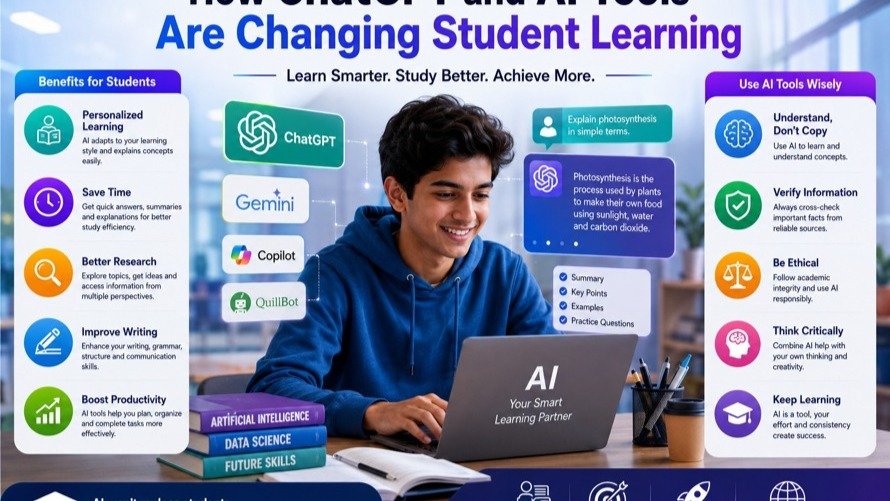
Personalized Learning Experience
Every student learns differently. AI tools can adapt to individual learning styles and provide customized explanations based on a student's needs. This personalized approach helps improve understanding and knowledge retention.
Faster Access to Information
Students no longer need to spend hours searching through multiple sources for basic information. AI-powered tools provide quick answers and organized explanations, helping students save valuable study time.
Improved Research Skills
AI tools help students explore topics, generate ideas, and understand concepts from different perspectives. They can act as research assistants that simplify information and support deeper learning.
Enhanced Writing and Communication
Many students use ChatGPT to improve grammar, structure essays, develop presentations, and enhance communication skills. AI can provide suggestions that help students create clearer and more professional academic work.
Better Study Efficiency
AI-powered study tools can generate summaries, flashcards, practice questions, and revision materials, helping students prepare more effectively for exams and assignments.
Challenges of Using AI in Education
While AI tools offer significant benefits, students should use them responsibly.
Overdependence on AI
Relying entirely on AI-generated answers can reduce critical thinking and
problem-solving abilities. Students should use AI as a learning assistant rather than a replacement for independent learning.
Accuracy and Verification
AI-generated information may occasionally contain errors or outdated information. Students should verify important facts using reliable educational sources.
Academic Integrity
Educational institutions encourage students to use AI ethically. Submitting AI-generated work without proper understanding or attribution may violate academic guidelines.
Best Practices for Students Using AI Tools
To maximize learning outcomes, students should:
● Use AI to understand concepts rather than copy answers.
● Verify information from trusted sources.
● Combine AI assistance with independent research.
● Develop critical thinking and analytical skills.
● Follow school and university AI policies.
Responsible use helps students gain the benefits of AI while maintaining academic integrity.
The Future of AI in Education
The role of AI in education is expected to expand significantly in the coming years. Future developments may include:
● AI-powered personal tutors
● Adaptive learning platforms
● Intelligent assessment systems
● Real-time language translation
● Personalized career guidance
These innovations have the potential to make education more accessible, efficient, and engaging for learners around the world.
Frequently Asked Questions
How does ChatGPT help students learn?
ChatGPT helps students understand concepts, conduct research, improve writing, and prepare for exams through instant educational support.
Can AI improve student performance?
When used responsibly, AI tools can improve productivity, enhance understanding, and support more effective learning strategies.
Is it safe for students to use AI tools?
Yes, provided students use reputable platforms, protect personal information, and verify important academic content.
Will AI replace teachers?
No. AI is designed to support education, while teachers continue to provide guidance, mentorship, critical thinking development, and human interaction.
What is the future of AI in education?
AI is expected to play a major role in personalized learning, intelligent tutoring, and educational accessibility while working alongside educators.
Conclusion
ChatGPT and other AI tools are transforming student learning by providing personalized support, improving study efficiency, and making educational resources more accessible. While these technologies offer significant advantages, students should use them responsibly and continue developing critical thinking, research, and problem-solving skills.
As AI continues to evolve, it will become an increasingly valuable part of modern education, helping students learn smarter, adapt faster, and prepare for the future workforce. By embracing AI as a learning companion rather than a shortcut, students can unlock new opportunities for academic and professional success.
Category: Industry Trends
Author: Techstas Research
Read time: 5 min read
Discover how ChatGPT and AI tools are transforming student learning, improving productivity, enhancing research skills, and shaping the future of education.